
Defining Orality
Foundations of Orality
This learning session aims to define what we call “orality”.
Trying to Define Orality
80% (8 out of every 10 people) of the world’s population depend on and prefer oral communication.1
We are born that way!
Rethink orality
🎞️
Watch this discussion about the definition of orality.
The definition story
🎞️
Watch the Definition Story
🎵
or listen to it.
Defining story

When I opened my eyes for the first time, I was blinded by the bright lights shining at my face. All I was able to do was to cry. When my eyes adjusted to the light, I saw three people in blue robes. They wore cold plastic gloves when they held me upside down and cut the line that connected me to another person. I was still wet when I was wrapped in a soft towel. They laid me down. I felt a warm hand gently caressing me. I felt safe. I stopped crying. Everything was silent. Suddenly I started to hear a rhythmic noise and felt a gentle pulsing movement. It was the familiar heartbeat I already knew for nine months. I was secure again!
I wanted to whisper, “I love you!” But I was not able to move my lips and vocal cords to express my inner speech. All I could do was to hold tide to the person holding me. Although I said nothing, this person understood. She looked into my eyes, smiled, and her eyes started to shine. Receiving this reaction surprised me and I did not know what it meant. All I knew is that it felt so good.
I was so happy that I smiled back. She smiled even harder. I quickly learned that a smile is an expression of joy. It was the first thing I truly understood. Over the next days this exchange of smiles kept happening. Every repetition of our rudimentary but heartfelt and deep communication made new connections in my very malleable brain so that I will remember this for the rest of my life.
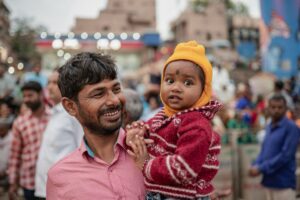
Another person, with a much deeper voice, also held me sometimes. I think he loved me also, but he was not as gentle as the first person. Since I was still not able to make noises, except crying when I was hungry, I started an experiment. Out of the blue, I smiled at him as hard as I possibly could. It worked! He smiled back at me. It was the first time that I passed on what I previously learned. I taught him how to smile!
Learning was fun. I wish this would go on for the rest of my life, but my desire was shattered at the age of almost seven years when grade one started to destroy my preferred learning strategy…
😃🤔🤯 With all the new information, rewrite your orality definition in one sentence.
Definition of orality
Learned expressions of inner speech using all senses to receive, process, remember, and pass on truth and information.2
Compare the definition with yours and then read the Shema Israel.
Moses: Listen, Israel! The Eternal is our True God—He alone. You should love Him, your True God, with all your heart and soul, with every ounce of your strength. Make the things I’m commanding you today part of who you are. Repeat them to your children. Talk about them when you’re sitting together in your home and when you’re walking together down the road. Make them the last thing you talk about before you go to bed and the first thing you talk about the next morning. Do whatever it takes to remember them: tie a reminder on your hand and bind a reminder on your forehead where you’ll see it all the time, such as on the doorpost where you cross the threshold or on the city gate.Text
Deuteronomy 6:4-9, VOICE
😃🤔🤯 How is God using our senses (🫳🏻👂🏻👅👃🏻👁️) to remind the Israelites to love Him?
😃🤔🤯 Where can you find receive, process, remember, and pass on?
Time to remember
Let’s put some of what we learned into practice.
😃🤔🤯 Recite the definition of orality. Make up a memorable gesture to each of the bold words as you repeat it several times. Once you master it, repeat it in front of others.
😃🤔🤯 Reimagine the definition of orality in an artistic form like a 🖼️ drawing, poem, 🎶 song, dance, etc. and present it to others.
Orality myths
- Orality is not illiteracy!
- Orality is not the opposite of textuality!
- Orality is not a method.
- Orality is not just storytelling.
- Orality is not a primitive way of thinking.
- Orality is not a strategy.
- Orality is not just a way of learning.
- Oral people are not “left behind”.
😃🤔🤯 Explain orality in such a simple way that it is easy for a 10-year-old to understand.
- 📃 Grant Lovejoy, “The Extent of Orality: The Word Become Flesh,” Orality Journal, no. The Word Become Flesh (2012): 11–40. ↩︎
- 📃 Charles Madinger, Rocelyn Madinger, and Daniel Ponraj, “Unleashing the Power of Orality,” OralityTalks Journal 1, no. 1 (2024): 19. ↩︎
🎉Congratulations, you finished this lesson!
Leave additional resources and ideas for others in the 💬comment section below!







Leave a Reply